
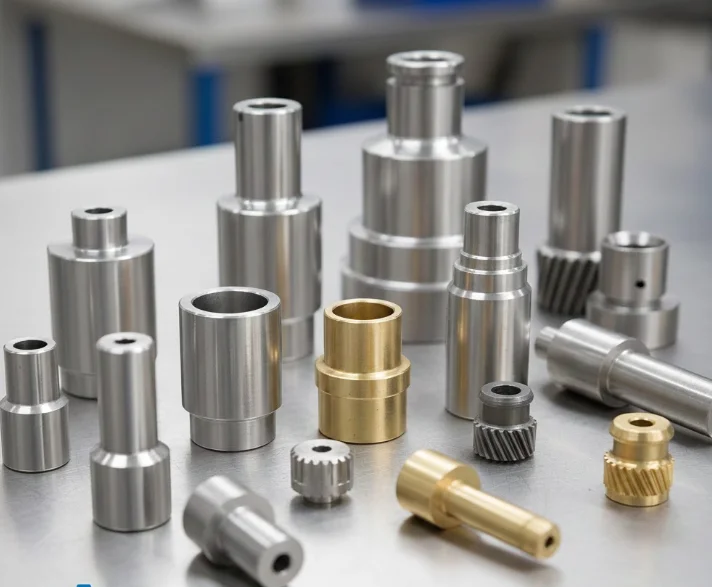
In today’s manufacturing landscape, precision, repeatability, and material versatility are no longer optional—they are fundamental requirements. As product designs become more complex and tolerances tighter, companies across aerospace, automotive, electronics, medical, and industrial automation increasingly rely on custom turning services to transform raw materials into high-performance components.
Unlike standard machining, custom turning is engineered around application-specific requirements, enabling manufacturers to meet exact dimensional, mechanical, and surface finish specifications.
What Is a Custom Turning Service
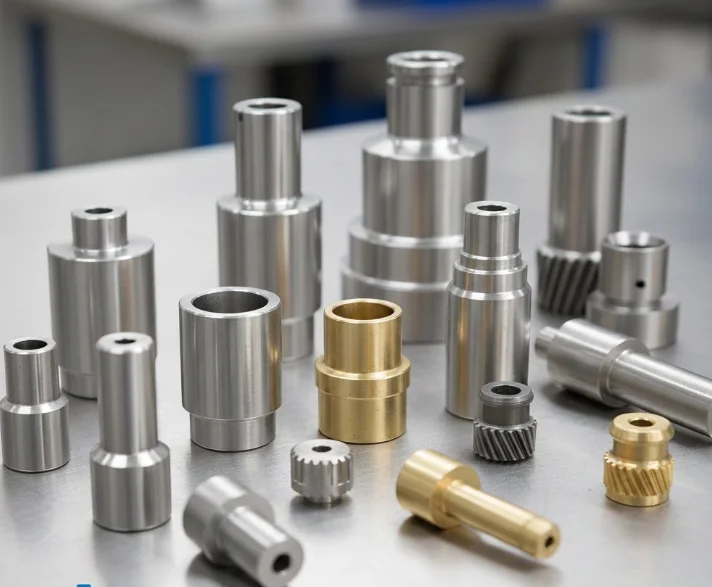
Custom turning is a subtractive machining process in which a rotating workpiece is shaped by a stationary cutting tool to achieve precise cylindrical, conical, or contoured geometries. What differentiates a custom turning service from generic turning lies in its ability to accommodate:
-
Non-standard dimensions and geometries
-
Tight tolerances and fine surface finishes
-
Specialized materials and alloys
-
Low-volume prototypes through high-volume production
Modern custom turning is typically performed using CNC lathes, ensuring exceptional accuracy, repeatability, and process control.
Core Capabilities of Advanced Custom Turning
High-Precision Dimensional Control
Custom turning services routinely achieve tolerances in the micrometer range, which is essential for components used in rotating assemblies, sealing interfaces, and load-bearing systems.
Material Versatility
A professional custom turning service supports a wide range of materials, including:
-
Carbon steel and alloy steel
-
Stainless steel
-
Aluminum and aluminum alloys
-
Brass and copper
-
Engineering plastics
This versatility allows engineers to optimize material selection based on strength, corrosion resistance, thermal stability, or cost.
Complex Geometry Machining
Advanced CNC turning enables:
-
Multi-step diameters
-
Grooves, threads, and tapers
-
Precision bores and internal features
-
Contoured and asymmetric profiles
Such capabilities are critical for parts that integrate mechanical, structural, and functional requirements.
Why Custom Turning Services Matter in Modern Industry
Design Freedom for Engineers
Custom turning removes many constraints associated with standard components. Engineers can design parts that match functional requirements precisely, rather than compromising around off-the-shelf limitations.
Improved Component Performance
By optimizing geometry, surface finish, and material selection, custom-turned components often exhibit:
-
Longer service life
-
Reduced friction and wear
-
Improved load distribution
-
Higher assembly accuracy
Cost Efficiency Over the Product Lifecycle
While custom parts may appear more expensive initially, they frequently reduce total cost by minimizing assembly issues, maintenance needs, and premature failures.
Key Industries Served by Custom Turning
Automotive and Transportation
Custom turning services produce shafts, bushings, pins, and fasteners that meet strict durability and tolerance standards.
Aerospace and Defense
High-precision, lightweight, and fatigue-resistant components are essential, making custom turning indispensable.
Industrial Machinery
Rotating parts, couplings, and housings require dimensional consistency to ensure system reliability.
Electronics and Automation
Miniaturized and high-accuracy components benefit from CNC custom turning, especially in connectors and motion systems.
Medical and Laboratory Equipment
Precision, cleanliness, and material compliance are critical, particularly for stainless steel and specialty alloys.
Quality Control in Custom Turning Services
A reliable custom turning service integrates quality at every stage of production:
-
Incoming material inspection
-
In-process dimensional checks
-
CNC program verification
-
Final inspection using CMM and precision gauges
This systematic approach ensures consistent quality, traceability, and compliance with customer specifications.
AICHI TECHNOLOGY and Precision Custom Turning
AICHI TECHNOLOGY operates with a manufacturing philosophy centered on precision engineering, process stability, and customer-specific solutions. In custom turning services, this translates into:
-
Advanced CNC turning equipment
-
Skilled machinists and engineers
-
Flexible production for prototypes and series orders
-
Strict quality management systems
By aligning machining strategies with application requirements, AICHI TECHNOLOGY supports clients seeking dependable, high-accuracy turned components for demanding industrial environments.
How to Choose the Right Custom Turning Service Provider
When selecting a custom turning partner, buyers should evaluate:
-
Technical capability – CNC equipment, tolerance range, and complexity handling
-
Material expertise – Experience with required metals or plastics
-
Quality assurance – Inspection methods and documentation
-
Production scalability – Ability to grow from prototype to mass production
-
Engineering support – Design feedback and manufacturability optimization
A capable provider acts not just as a supplier, but as a manufacturing partner.
Conclusion
Custom turning services are a cornerstone of precision manufacturing, enabling industries to convert complex designs into reliable, high-performance components. By combining advanced CNC technology, material expertise, and rigorous quality control, custom turning delivers measurable value across the product lifecycle.
With its focus on engineering precision and customer-driven solutions, AICHI TECHNOLOGY stands as a capable partner for businesses seeking dependable and scalable custom turning services in a competitive global market.

 English
 Arabic
 French
 Spanish
 Portuguese
 Deutsch
 Turkish
 Dutch
Dutch
 Italiano
 Russian
 Portuguese (Brazil)
 Greek
Greek
Warning: Undefined array key "_is_photo" in /home/senmarri/public_html/friend24.in/content/themes/default/templates_compiled/9ea4999d05077b6b690d81624544cd64a51b1299_0.file.__feeds_post.comments.tpl.php on line 27
Warning: Attempt to read property "value" on null in /home/senmarri/public_html/friend24.in/content/themes/default/templates_compiled/9ea4999d05077b6b690d81624544cd64a51b1299_0.file.__feeds_post.comments.tpl.php on line 27
" style="background-image:url(
Warning: Undefined array key "user_picture" in /home/senmarri/public_html/friend24.in/content/themes/default/templates_compiled/19bd7b5d2fc32801d9316dbc2d8c5b25c99e72c3_0.file.__feeds_comment.form.tpl.php on line 31
);">
/home/senmarri/public_html/friend24.in/content/themes/default/templates_compiled/9ea4999d05077b6b690d81624544cd64a51b1299_0.file.__feeds_post.comments.tpl.php on line 128
Warning: Attempt to read property "value" on null in /home/senmarri/public_html/friend24.in/content/themes/default/templates_compiled/9ea4999d05077b6b690d81624544cd64a51b1299_0.file.__feeds_post.comments.tpl.php on line 128
">