
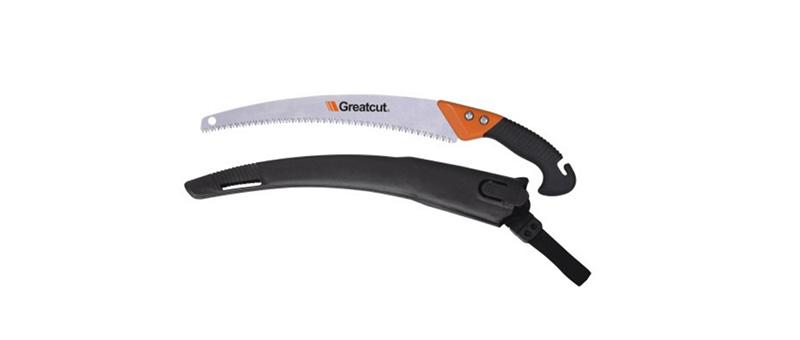
The pruning saw stands as a specialized instrument in the horticultural toolkit, designed for the specific task of cutting through living wood with precision and minimal damage to plant tissues. Unlike standard saws intended for construction or lumber, the pruning saw is engineered to make clean, controlled cuts that facilitate rapid healing of the tree or shrub. This tool becomes indispensable when branches exceed the capacity of handheld shears, typically for diameters ranging from one to several inches. The unique tooth pattern of a pruning saw, often featuring triple-cut or razor-tooth designs, allows for efficient material removal on both the push and pull strokes. For arborists and dedicated gardeners, a reliable pruning saw is not merely a convenience but a necessity for maintaining plant health and structural integrity. The thoughtful application of this tool supports the long-term vitality of woody plants in cultivated landscapes.
The physical characteristics of a pruning saw are tailored to its demanding outdoor work. The blade, typically crafted from high-carbon steel or chromium-plated alloy, is designed to maintain a sharp edge through repeated use on abrasive wood fibers. Many modern versions of the pruning saw feature a curved blade that conforms naturally to the rounded shape of branches, providing better leverage and reducing the chance of the tool binding during a cut. The handle of a pruning saw receives considerable attention in its design, requiring an ergonomic grip that ensures control and reduces hand fatigue during extended use. Safety is another consideration, with some models incorporating a blade guard or a folding mechanism that covers the teeth when the pruning saw is not in use. This feature protects both the user and the sharpness of the blade during transport and storage, making the pruning saw a safer instrument to carry through the garden.
The practical application of a pruning saw involves technique and understanding of plant biology. The fundamental approach when using a pruning saw involves making a clean cut just outside the branch collar, the swollen area where the branch meets the trunk, to encourage proper callus formation. For larger limbs, the three-cut method is recommended to prevent bark tearing: an undercut is made first, followed by a top cut further out to remove the weight of the branch, and finished with a final precision cut using the pruning saw close to the trunk. Maintaining the tool is straightforward; cleaning sap from the blade after use and occasional sharpening will keep a pruning saw performing effectively. Proper storage of the pruning saw in a dry environment prevents rust and preserves the cutting ability of the teeth. A well-maintained pruning saw becomes a long-term partner in garden care, reliably serving its purpose season after season.
The pruning saw represents a thoughtful convergence of specialized design and practical function for woody plant management. Its continued use by professionals and enthusiasts underscores its effectiveness in performing cuts that promote plant health and controlled growth. The development of new blade steels and handle materials continues to refine the user experience and durability of the modern pruning saw. As a dedicated tool for a specific horticultural task, the pruning saw maintains its fundamental role in the careful stewardship of trees and shrubs.

 English
 Arabic
 French
 Spanish
 Deutsch
 Turkish
 Dutch
Dutch
 Italiano
 Russian
 Romaian
 Portuguese (Brazil)
 Greek
Greek
Warning: Undefined array key "_is_photo" in /home/senmarri/public_html/friend24.in/content/themes/default/templates_compiled/9ea4999d05077b6b690d81624544cd64a51b1299_0.file.__feeds_post.comments.tpl.php on line 27
Warning: Attempt to read property "value" on null in /home/senmarri/public_html/friend24.in/content/themes/default/templates_compiled/9ea4999d05077b6b690d81624544cd64a51b1299_0.file.__feeds_post.comments.tpl.php on line 27
" style="background-image:url(
Warning: Undefined array key "user_picture" in /home/senmarri/public_html/friend24.in/content/themes/default/templates_compiled/19bd7b5d2fc32801d9316dbc2d8c5b25c99e72c3_0.file.__feeds_comment.form.tpl.php on line 31
);">
/home/senmarri/public_html/friend24.in/content/themes/default/templates_compiled/9ea4999d05077b6b690d81624544cd64a51b1299_0.file.__feeds_post.comments.tpl.php on line 128
Warning: Attempt to read property "value" on null in /home/senmarri/public_html/friend24.in/content/themes/default/templates_compiled/9ea4999d05077b6b690d81624544cd64a51b1299_0.file.__feeds_post.comments.tpl.php on line 128
">