
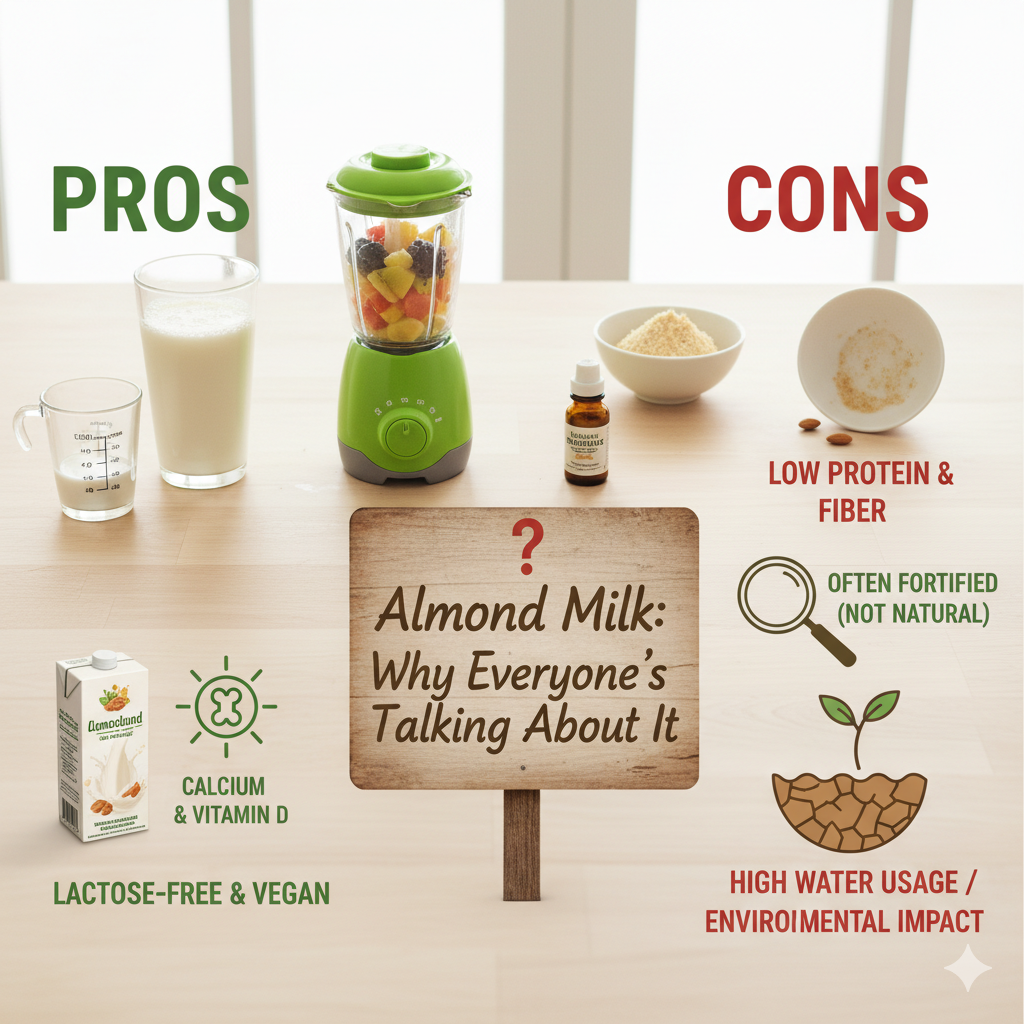
Almond milk has moved far beyond being a niche product to become a dominant force in the dairy-free market. Loved for its mild, nutty flavor and versatility, it's a staple in lattes, smoothies, and cereal bowls worldwide. But is this trendy beverage truly a healthy choice for you, or are there drawbacks lurking beneath the surface?
Before you commit to making the switch, it's essential to understand the complete picture. We'll dive deep into the nutritional facts, health benefits, environmental concerns, and potential pitfalls of this popular plant-based drink.
The Nutritional Snapshot: What’s in Your Carton?
Almond milk is made by blending ground almonds with water and then straining the mixture to remove the solids. Because it's mostly water (often 95% or more), its nutritional profile can be quite different from the whole nut.
Here is a look at the typical nutritional breakdown of one cup (8 ounces or 240 mL) of unsweetened, fortified almond milk compared to cow's milk:
| Nutrient | Unsweetened Almond Milk (Approx.) | Cow's Milk (2% Fat, Approx.) |
| Calories | 35–40 | 122 |
| Protein | $\sim$1 gram | 8 grams |
| Carbohydrates | 1–2 grams | 12 grams |
| Total Fat | 3 grams | 5 grams |
| Saturated Fat | 0 grams | 3 grams |
| Calcium | Often fortified (30-45% DV) | $\sim$30% DV |
| Vitamin D | Often fortified (15-25% DV) | $\sim$15% DV |
| Vitamin E | High (Often $50\%+$ DV) | Trace amounts |
Note: Nutrition can vary significantly by brand and whether the milk is sweetened or fortified. Always check the [Almond Milk Ingredients Label] for the most accurate information.
🌟 The Pros of Choosing Almond Milk
Almond milk offers a compelling set of advantages, making it an excellent choice for many dietary needs and lifestyles.
1. Naturally Dairy-Free and Allergen-Friendly
-
Lactose-Intolerance Solution: Almond milk is naturally lactose-free, making it a perfect substitute for those with lactose intolerance, an extremely common digestive issue.
-
Vegan and Plant-Based: It is a key player in the vegan and plant-based movements, providing a versatile, animal-free "milk" for every recipe and drink.
2. A Low-Calorie Champion
If your goal is [Weight Management], unsweetened almond milk is your ally. With only 35–40 calories per cup—a fraction of the calories in whole milk—it allows you to enjoy your coffee, cereal, and smoothies with minimal caloric impact. The very low sugar and carbohydrate content in the unsweetened version is also favorable for those monitoring blood sugar levels or following a low-carb diet.
3. Fortified for Bone Health
While almonds aren't naturally high in calcium, most commercial almond milk brands are fortified with calcium and Vitamin D, two critical nutrients for [Strong Bones and Teeth]. This fortification ensures that people avoiding dairy can still meet their daily requirements for these essential minerals, crucial for preventing conditions like osteoporosis.
4. Rich in Vitamin E and Antioxidants
Almond milk is naturally high in Vitamin E, a powerful antioxidant. This nutrient helps protect your cells from damage caused by free radicals, supporting [Skin Health], vision, and a robust immune system.
5. Heart-Healthy Fats
The small amount of fat in almond milk is primarily unsaturated fat, the kind considered beneficial for heart health. These monounsaturated fats may help reduce "bad" LDL cholesterol levels, supporting overall cardiovascular wellness.
🛑 The Cons and Drawbacks to Consider
Despite its advantages, almond milk has some significant drawbacks you should be aware of before fully committing to it.
1. Critically Low Protein Content
This is perhaps almond milk’s biggest nutritional disadvantage. With only $\sim$1 gram of protein per cup, it offers far less than cow's milk (8g) or even soy milk (6-8g). Protein is vital for [Muscle Growth and Satiety]. If you rely on milk for a significant portion of your protein, almond milk will leave a considerable gap in your diet that needs to be filled by other sources like eggs, lean meat, or legumes.
2. Hidden Sugars and Additives
Sweetened or flavored almond milks (like vanilla or chocolate) can contain significant amounts of added sugar. This unnecessary sugar intake increases the calorie count and negates the benefits of choosing the low-sugar alternative. Furthermore, many commercial brands use thickeners and stabilizers (like carrageenan, gums, or emulsifiers) to improve texture and shelf life. While generally considered safe, some people report digestive distress from these additives, and they can dilute the amount of actual almond content.
3. Not Suitable for Tree Nut Allergies
This is a fundamental health risk: almond milk is strictly off-limits for anyone with a tree nut allergy. This can lead to severe, life-threatening allergic reactions.
4. Environmental Impact: The Water Footprint
Sustainability is a major concern. Almond cultivation, particularly in California where most U.S. almonds are grown, is extremely water-intensive. It takes significantly more water to produce an almond than to grow oats or soybeans. For the [Environmentally Conscious Consumer], this high "water footprint" may be a deciding factor against choosing almond milk over other plant-based alternatives like oat or soy milk.
5. Not a Complete Replacement for Infants and Young Children
Due to its low protein, low-fat, and overall lower micronutrient density compared to dairy milk, almond milk is generally not recommended as a primary milk source for infants and toddlers who require higher fat and protein intake for proper growth and development, unless guided by a pediatrician.
Making the Best Choice for You
Ultimately, whether almond milk is the right choice depends on your personal health goals and dietary needs.
-
If your priority is low-calorie and low-carb intake (for weight loss or blood sugar management), unsweetened almond milk is an excellent choice, provided you get your protein and other nutrients from other food sources.
-
If you are replacing a primary source of protein (for muscle building or satiety), you may be better off choosing a plant-based milk with higher protein content, such as soy milk, or ensuring you pair your almond milk with a protein-rich food (like a handful of nuts or protein powder).
-
Always read the label: Choose unsweetened, fortified varieties to avoid added sugars and to ensure you are getting bone-supporting calcium and Vitamin D.
Almond milk is a versatile, delicious, and low-calorie alternative that fits perfectly into vegan and lactose-free diets. By being mindful of its limitations—especially the low protein and potential for added sugars—you can make an informed decision that supports your overall health and wellness.

 English
 Arabic
 French
 Spanish
 Portuguese
 Deutsch
 Turkish
 Italiano
 Russian
 Romaian
 Portuguese (Brazil)
 Greek
Greek
Warning: Undefined array key "_is_photo" in /home/senmarri/public_html/friend24.in/content/themes/default/templates_compiled/9ea4999d05077b6b690d81624544cd64a51b1299_0.file.__feeds_post.comments.tpl.php on line 27
Warning: Attempt to read property "value" on null in /home/senmarri/public_html/friend24.in/content/themes/default/templates_compiled/9ea4999d05077b6b690d81624544cd64a51b1299_0.file.__feeds_post.comments.tpl.php on line 27
" style="background-image:url(
Warning: Undefined array key "user_picture" in /home/senmarri/public_html/friend24.in/content/themes/default/templates_compiled/19bd7b5d2fc32801d9316dbc2d8c5b25c99e72c3_0.file.__feeds_comment.form.tpl.php on line 31
);">
/home/senmarri/public_html/friend24.in/content/themes/default/templates_compiled/9ea4999d05077b6b690d81624544cd64a51b1299_0.file.__feeds_post.comments.tpl.php on line 128
Warning: Attempt to read property "value" on null in /home/senmarri/public_html/friend24.in/content/themes/default/templates_compiled/9ea4999d05077b6b690d81624544cd64a51b1299_0.file.__feeds_post.comments.tpl.php on line 128
">