
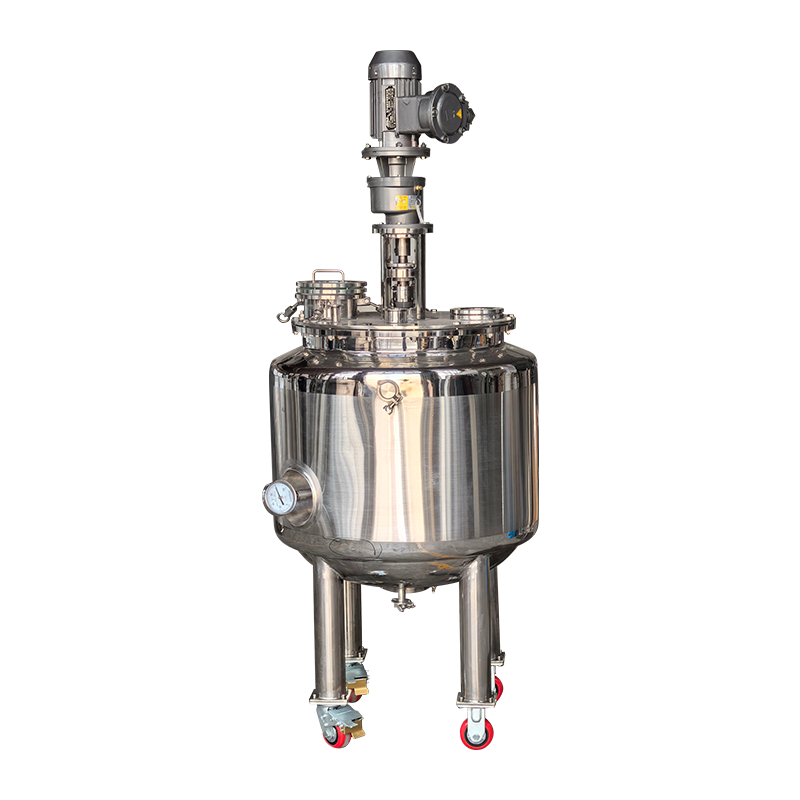
Reaction kettles are fundamental vessels used in chemical, pharmaceutical, and food industries to conduct controlled chemical reactions and mixing processes. These containers are designed to provide a secure environment where raw materials can be combined, heated, cooled, or agitated under specific conditions. A standard reaction kettle typically consists of a main vessel, an agitation system, a heating or cooling jacket, and various ports for adding ingredients or monitoring the process. The primary purpose of a reaction kettle is to create a controlled space where temperature, pressure, and mixing can be managed to achieve a desired chemical transformation or physical blend.
The construction material of a reaction kettle is selected based on the process requirements. For corrosive substances, a reaction kettle may be lined with glass, or constructed from stainless steel, hastelloy, or other specialized alloys. The internal surface of the reaction kettle is often polished to a smooth finish to prevent material buildup and allow for easy cleaning. The vessel of a reaction kettle is typically cylindrical with a dished bottom, a design that promotes efficient mixing and heat transfer. The structural integrity of a reaction kettle is vital to withstand the internal pressures and mechanical stresses encountered during operation.
The agitation system is a critical feature of a reaction kettle. An electric motor drives an impeller shaft that enters the reaction kettle through a sealed opening. Different impeller designs are used in a reaction kettle depending on the viscosity of the contents and the mixing objective. Some reaction kettles feature multiple impellers or a combination of scraping blades and dispersers to handle complex mixtures. The seal around the agitator shaft is a key component of the reaction kettle, preventing leaks and maintaining the internal atmosphere, especially when processing volatile or hazardous materials.
Heating and temperature control are essential functions of a reaction kettle. Many reaction kettles are equipped with a jacketed wall. A thermal fluid—such as steam, hot water, or oil—is circulated through this jacket of the reaction kettle to heat the contents. Conversely, cold water or coolant can be circulated to remove heat. Precise temperature control within the reaction kettle is often managed by an external control system connected to temperature probes inside the vessel. The ability to accurately control thermal conditions makes the reaction kettle a versatile tool for processes ranging from simple heating to complex chemical syntheses that require specific thermal profiles.

 English
 Arabic
 French
 Spanish
 Portuguese
 Turkish
 Dutch
Dutch
 Italiano
 Russian
 Romaian
 Portuguese (Brazil)
 Greek
Greek
Warning: Undefined array key "_is_photo" in /home/senmarri/public_html/friend24.in/content/themes/default/templates_compiled/9ea4999d05077b6b690d81624544cd64a51b1299_0.file.__feeds_post.comments.tpl.php on line 27
Warning: Attempt to read property "value" on null in /home/senmarri/public_html/friend24.in/content/themes/default/templates_compiled/9ea4999d05077b6b690d81624544cd64a51b1299_0.file.__feeds_post.comments.tpl.php on line 27
" style="background-image:url(
Warning: Undefined array key "user_picture" in /home/senmarri/public_html/friend24.in/content/themes/default/templates_compiled/19bd7b5d2fc32801d9316dbc2d8c5b25c99e72c3_0.file.__feeds_comment.form.tpl.php on line 31
);">
/home/senmarri/public_html/friend24.in/content/themes/default/templates_compiled/9ea4999d05077b6b690d81624544cd64a51b1299_0.file.__feeds_post.comments.tpl.php on line 128
Warning: Attempt to read property "value" on null in /home/senmarri/public_html/friend24.in/content/themes/default/templates_compiled/9ea4999d05077b6b690d81624544cd64a51b1299_0.file.__feeds_post.comments.tpl.php on line 128
">