
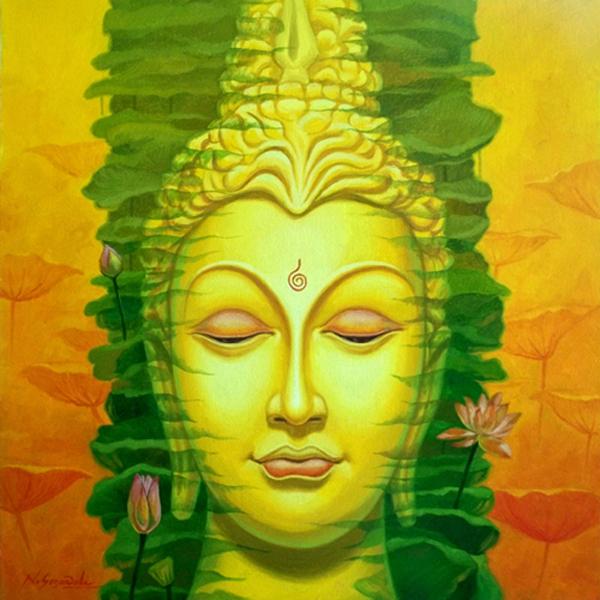
Art in India has always been more than an aesthetic pursuit; it is a profound reflection of philosophy, spirituality, and culture. Among the diverse streams of Indian paintings, the timeless imagery of Buddha continues to hold a central place. Whether on the walls of Ajanta caves, in serene miniature schools of art, or in modern canvases that reinterpret spiritual ideals, Buddha paintings embody peace, mindfulness, and enlightenment. In an age where art is often viewed as an investment or décor, these works remind us that true artistry lies in its ability to nurture the soul.
This post explores the spiritual depth of Buddha paintings, their significance in the broader narrative of Indian paintings, and how collectors and art lovers can engage with this genre meaningfully.
The Legacy of Buddha in Indian Art
The journey of Buddha as an artistic subject begins with early Indian mural traditions, such as those in Ajanta and Ellora. Artists used pigments derived from natural minerals to depict stories from the Jataka tales—narratives of Buddha’s previous lives. These visual stories were not mere decoration but teaching tools meant to communicate dharma to devotees.
Later, during the Mughal and Rajput periods, Buddhist iconography intertwined with miniature traditions, evolving into more symbolic representations. Gold halos, lotus motifs, and meditative postures became markers of divinity and tranquility. Even in modern Indian art, leading painters have drawn upon the Buddha’s image, experimenting with abstraction and symbolism to align ancient spirituality with contemporary aesthetics.
The significance of Buddha paintings is not limited to religious devotion. They represent India’s broader artistic philosophy, where form, symbolism, and spirituality converge to create timeless art.
Why Buddha Paintings Resonate Today
In today’s fast-paced, digitally driven world, the enduring calm of Buddha’s image resonates more strongly than ever. Collectors and homeowners alike turn to Buddha paintings not just for their visual appeal but for their ability to inspire mindfulness and harmony within living spaces.
Key reasons for their relevance:
-
Spiritual Calm in Modern Spaces – The gentle expressions and meditative postures of Buddha create an environment of tranquility, making these paintings perfect for homes, yoga studios, and meditation centers.
-
Cultural Continuity – Owning Buddha paintings connects individuals with the rich spiritual traditions of India, offering more than mere decoration.
-
Symbolism of Enlightenment – The image of Buddha transcends religion, appealing to universal ideals of compassion, wisdom, and inner peace.
-
Art as Therapy – Modern psychology increasingly acknowledges art’s therapeutic power. Buddha paintings, with their calming compositions, serve as visual anchors for stress relief and introspection.
Collecting Buddha Paintings: Actionable Advice
For collectors, enthusiasts, and art investors, engaging with Buddha paintings requires both sensitivity and discernment. Here are some actionable insights:
-
Understand the School and Style – Traditional Buddha paintings vary widely: from Ajanta-inspired frescoes to Tibetan thangka influences, to Bengal School minimalism. Knowing the origin enriches appreciation and helps identify authenticity.
-
Look for Symbolism – Each hand gesture (mudra), lotus, or aura in Buddha paintings holds deep meaning. For instance, the “Dharmachakra Mudra” symbolizes teaching, while the “Abhaya Mudra” denotes protection and reassurance.
-
Balance Tradition and Modernity – While antique or traditional works hold immense historical value, contemporary Indian artists are reimagining Buddha in new palettes and abstract styles. A balanced collection bridges heritage and innovation.
-
Verify Authenticity – The Indian art market is vibrant but also unregulated in parts. Collectors should work with trusted galleries and platforms that provide certification and provenance.
-
Placement Matters – From an interior design perspective, Buddha paintings work best in calm, reflective spaces. Choosing the right size, color palette, and placement enhances both aesthetic and spiritual impact.
The Broader Context: Buddha within Indian Paintings
While Buddha paintings form a significant niche, their relevance is magnified when seen as part of the larger landscape of Indian paintings. Indian art is a vast spectrum—ranging from the religious depictions of Pattachitra and Madhubani, to the royal grandeur of Rajput and Mughal miniatures, and further to modern masters like M.F. Husain and Tyeb Mehta.
In this context, Buddha paintings serve as a bridge between tradition and modernity. They remind us that while Indian art continues to evolve, its foundation lies in themes that transcend time: spirituality, human experience, and universal truths.
For global collectors, Buddha paintings also represent India’s soft power—its ability to convey messages of peace and harmony through art. This is particularly relevant today, when cultural diplomacy and art commerce intersect.
Future Perspectives: The Evolving Role of Buddha Paintings
As technology reshapes the art world, Buddha paintings too are entering new spaces. Digital reproductions, NFT art forms, and virtual exhibitions are extending their reach beyond physical galleries. At the same time, sustainability-conscious artists are experimenting with organic pigments and eco-friendly canvases to align spiritual art with ecological mindfulness.
Looking ahead, Buddha paintings may well become central to the global wellness movement. With mindfulness, meditation, and holistic living gaining worldwide traction, art that embodies these values will only grow in demand. For collectors, this offers both cultural enrichment and long-term value.
Conclusion: The Eternal Serenity of Buddha in Art
Buddha paintings are not just an artistic genre; they are visual meditations that invite viewers to pause, reflect, and reconnect with inner peace. Their place in the broader tapestry of Indian paintings illustrates the unique power of Indian art to transcend time, geography, and even religious boundaries.
For collectors, the takeaway is clear: investing in Buddha paintings is not only about acquiring art but also about embracing a philosophy of balance, compassion, and mindfulness. For art lovers, it is a reminder that true beauty lies not in ornate detail or market value alone, but in the quiet resonance of a work that stirs the soul.
As the world grows noisier, Buddha’s calm gaze on canvas offers us a timeless sanctuary—a gentle reminder that art, at its best, is a path to enlightenment.

 Arabic
 French
 Spanish
 Portuguese
 Deutsch
 Turkish
 Dutch
Dutch
 Italiano
 Russian
 Romaian
 Portuguese (Brazil)
 Greek
Greek
Warning: Undefined array key "_is_photo" in /home/senmarri/public_html/friend24.in/content/themes/default/templates_compiled/9ea4999d05077b6b690d81624544cd64a51b1299_0.file.__feeds_post.comments.tpl.php on line 27
Warning: Attempt to read property "value" on null in /home/senmarri/public_html/friend24.in/content/themes/default/templates_compiled/9ea4999d05077b6b690d81624544cd64a51b1299_0.file.__feeds_post.comments.tpl.php on line 27
" style="background-image:url(
Warning: Undefined array key "user_picture" in /home/senmarri/public_html/friend24.in/content/themes/default/templates_compiled/19bd7b5d2fc32801d9316dbc2d8c5b25c99e72c3_0.file.__feeds_comment.form.tpl.php on line 31
);">
/home/senmarri/public_html/friend24.in/content/themes/default/templates_compiled/9ea4999d05077b6b690d81624544cd64a51b1299_0.file.__feeds_post.comments.tpl.php on line 128
Warning: Attempt to read property "value" on null in /home/senmarri/public_html/friend24.in/content/themes/default/templates_compiled/9ea4999d05077b6b690d81624544cd64a51b1299_0.file.__feeds_post.comments.tpl.php on line 128
">