
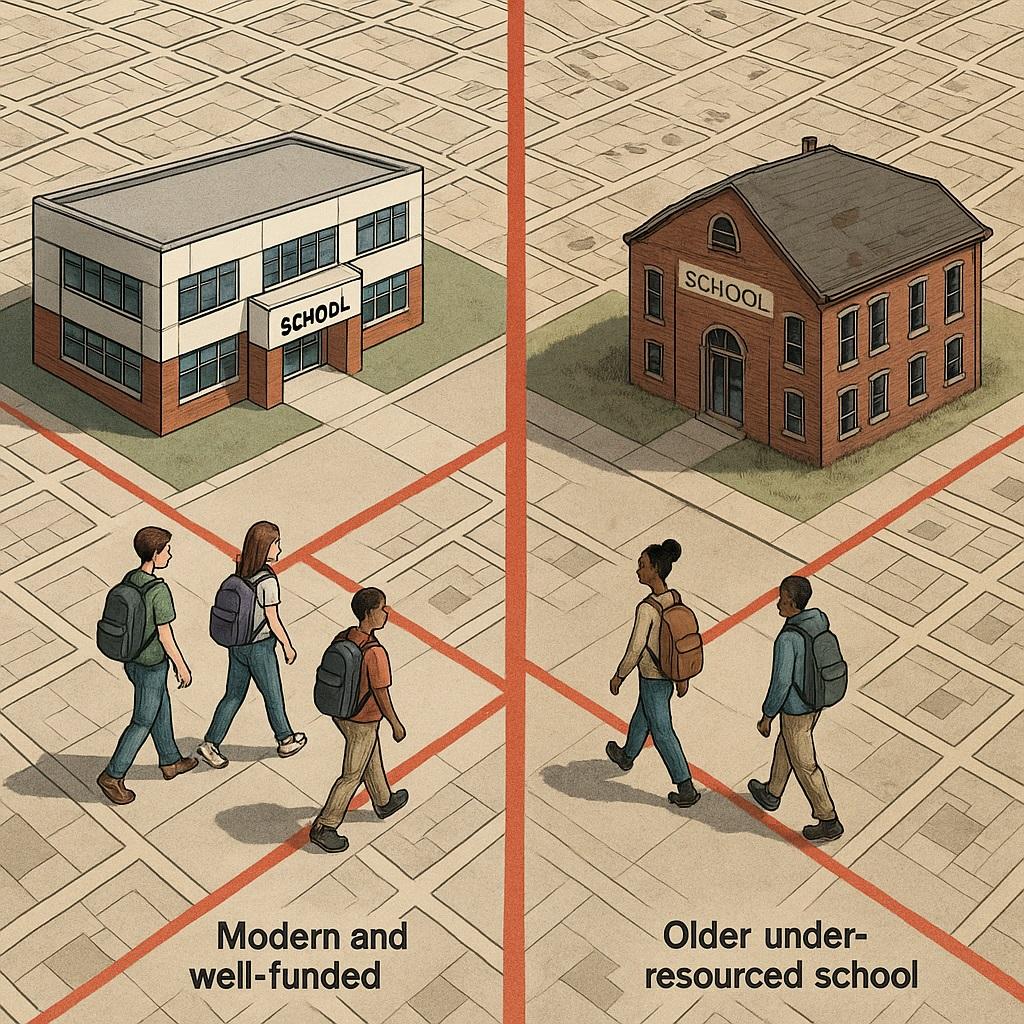
In the United States, a child’s zip code can determine far more than where they live it can dictate the quality of education they receive. School zoning laws, which decide which students attend which schools based on residential boundaries, have long been a source of debate. Critics argue that zoning reinforces inequality by linking school quality to neighborhood wealth, creating stark educational divides between districts.
For a deeper perspective, the article School Zoning Unequal Education – Understanding the Divide explores the root causes and consequences of this system, shedding light on why the debate continues to grow in urgency.
What Is School Zoning?
School zoning is the process by which school districts assign students to schools based on geographic boundaries. The goal is to ensure that local schools serve nearby families, fostering community cohesion. On paper, zoning seems like a straightforward way to organize education. In practice, however, it often mirrors and reinforces residential segregation and income disparities.
Wealthier neighborhoods, where property values are higher, typically have better-funded schools. Families moving into these areas often do so specifically to access highly ranked schools, creating a cycle where housing markets and school quality reinforce one another. Meanwhile, students in lower-income zones may be left with underfunded schools that struggle to provide equal opportunities.
The Link Between Housing Wealth and Education Quality
Because public school funding is tied heavily to local property taxes, the quality of education is often directly connected to the wealth of the community. Districts with expensive homes generate more tax revenue, which translates into higher teacher salaries, better facilities, and more extracurricular programs.
By contrast, schools in less affluent zones face challenges such as outdated textbooks, limited technology, and fewer advanced placement courses. These disparities mean that students’ access to quality education depends less on their abilities and more on where their families can afford to live.
Inequality in Access and Opportunity
One of the most troubling aspects of school zoning is how it limits opportunities for students. Children growing up in high-poverty neighborhoods may never have access to the same educational resources as their peers in wealthier communities. This inequality is not only academic but social. Extracurricular activities, arts programs, and advanced classes—all common in affluent schools—help shape a student’s overall development and future opportunities.
For many families, moving to a different school zone is simply not possible due to housing costs. This effectively traps students in under-resourced schools and perpetuates cycles of poverty and inequality.
School Choice: A Proposed Alternative
To address the flaws of strict zoning, many states have introduced school choice programs. These include charter schools, magnet schools, and voucher systems that allow families to select schools outside their immediate neighborhoods. Proponents argue that school choice gives parents more control and offers students a path out of struggling schools.
However, critics caution that school choice can also deepen inequalities. Wealthier families are often better equipped to navigate application processes, transportation challenges, and tuition gaps that accompany private options. Without careful regulation, choice programs risk leaving the most vulnerable students behind.
The Role of Charter and Magnet Schools
Charter and magnet schools are often presented as solutions to zoning-related inequities. Charter schools, funded publicly but run independently, offer flexibility in curriculum and management. Magnet schools, meanwhile, focus on specialized subjects like science, arts, or technology and are designed to attract a diverse student body from different zones.
While successful examples exist, not all charter and magnet schools deliver consistent results. In some cases, they outperform traditional schools, while in others, they struggle with accountability and oversight. Their growth highlights both the demand for alternatives and the complexity of addressing zoning inequities.
The Broader Social Divide
School zoning not only reflects educational disparities but also deepens social divides. Affluent districts attract more resources, better teachers, and active parental involvement. In contrast, underfunded schools in struggling areas must contend with higher student needs, teacher shortages, and limited community investment.
This divide has long-term implications. Students who lack access to quality education face reduced college opportunities, lower earning potential, and greater economic challenges in adulthood. The zoning system, therefore, not only impacts schools but shapes broader patterns of inequality across society.
Policy Solutions and Reforms
Addressing school zoning inequities requires comprehensive policy reforms. Some proposals include:
-
Reevaluating funding models: Reducing reliance on property taxes and increasing state or federal contributions to balance resources across districts.
-
Redrawing district boundaries: Creating more balanced zones that reflect socioeconomic diversity.
-
Expanding transportation access: Ensuring students can attend schools outside their immediate neighborhood.
-
Strengthening accountability in choice programs: Requiring transparency and performance standards for charter and private schools receiving public funds.
While these solutions are complex, they offer pathways toward narrowing the educational divide.
Conclusion: Breaking the Cycle of Inequality
The issue of school zoning and unequal education strikes at the heart of the American promise of equal opportunity. When a child’s educational prospects depend on their neighborhood, it challenges the fairness and inclusiveness of the entire system.
Breaking this cycle will require bold reforms, investments, and a reimagining of how schools are funded and accessed. Until then, the debate over zoning and education will remain central to discussions about equity, fairness, and the future of American schools.

 English
 Arabic
 French
 Spanish
 Portuguese
 Turkish
 Dutch
Dutch
 Italiano
 Russian
 Romaian
 Portuguese (Brazil)
 Greek
Greek
Warning: Undefined array key "_is_photo" in /home/senmarri/public_html/friend24.in/content/themes/default/templates_compiled/9ea4999d05077b6b690d81624544cd64a51b1299_0.file.__feeds_post.comments.tpl.php on line 27
Warning: Attempt to read property "value" on null in /home/senmarri/public_html/friend24.in/content/themes/default/templates_compiled/9ea4999d05077b6b690d81624544cd64a51b1299_0.file.__feeds_post.comments.tpl.php on line 27
" style="background-image:url(
Warning: Undefined array key "user_picture" in /home/senmarri/public_html/friend24.in/content/themes/default/templates_compiled/19bd7b5d2fc32801d9316dbc2d8c5b25c99e72c3_0.file.__feeds_comment.form.tpl.php on line 31
);">
/home/senmarri/public_html/friend24.in/content/themes/default/templates_compiled/9ea4999d05077b6b690d81624544cd64a51b1299_0.file.__feeds_post.comments.tpl.php on line 128
Warning: Attempt to read property "value" on null in /home/senmarri/public_html/friend24.in/content/themes/default/templates_compiled/9ea4999d05077b6b690d81624544cd64a51b1299_0.file.__feeds_post.comments.tpl.php on line 128
">