
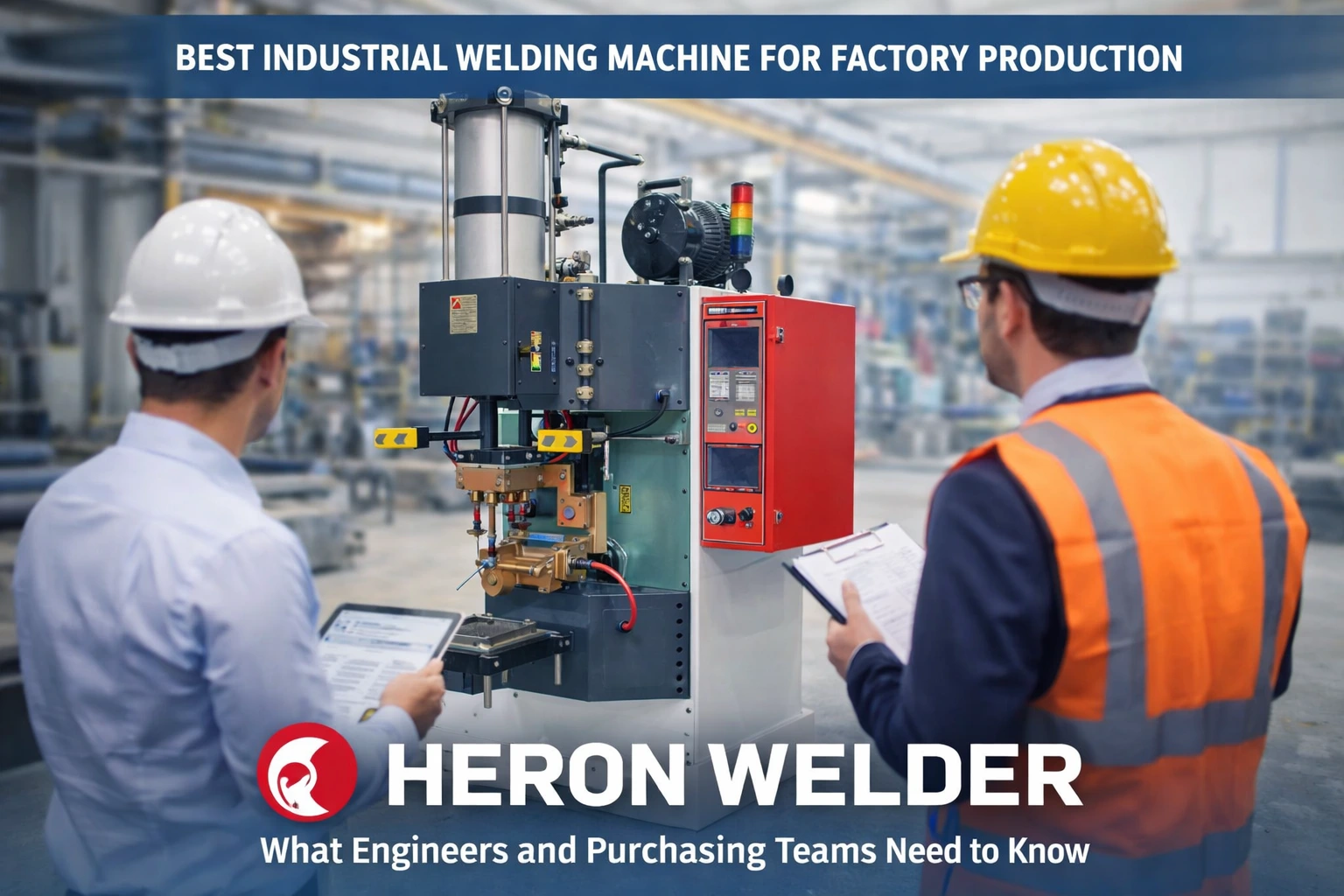
In high-speed, high-precision assembly environments, spot welding equipment remains a foundation of resistance welding technology. From automotive bodies to appliance components, electronics enclosures to HVAC panels, spot welding delivers repeatable, energy-efficient metal joining with minimal footprint. For manufacturing engineers, OEMs, and automation integrators evaluating welding solutions, understanding the technical principles, equipment options, and best practices is critical for maximizing throughput, quality, and long-term reliability.
At Heron Welder, a global leader in industrial welding and metal-joining equipment, we design and manufacture advanced resistance welding machines—including spot, projection, seam, MFDC, and capacitor discharge welders, plus welding guns, controllers, and fully automated production systems—tailored to complex manufacturing requirements.
What Is Spot Welding Equipment?
Spot welding equipment refers to machines that join two or more overlapping metal sheets by applying localized pressure and electrical current through copper alloy electrodes. The current generates heat via electrical resistance at the interface of the sheets, causing the material to liquefy and form a solid weld “spot” upon cooling.
Core Components of Spot Welding Equipment
-
Transformer & Power Supply: Delivers controlled electrical energy — traditionally AC, or modern MFDC (Medium Frequency Direct Current) for tighter process control.
-
Electrode Arms & Holders: Provide precise force and current delivery.
-
Copper Alloy Electrodes: Conduct current while minimizing wear and thermal diffusion.
-
Controller & Interface: Programmable logic for parameters such as weld time, current, force, and sequence.
-
Frame & Actuators: Mechanically deliver consistent weld force, either pneumatic, hydraulic, or servo-driven.
How Spot Welding Works: The Technical Fundamentals
At its essence, spot welding exploits resistance heating and controlled force:
-
Clamping Force: Electrodes press metal sheets together at the weld zone.
-
Current Pulse: A high-amperage pulse (often several thousand amps) is discharged for a precise duration.
-
Joule Heating: Resistance at the metal interface generates heat proportional to current² × resistance × time.
-
Nugget Formation: Heat melts the interface, forming a metallurgical bond or “nugget.”
-
Cooling & Solidification: With current removed but force maintained, the weld cools under pressure to solidify.
Control of weld current, time, and force is critical. Too little energy yields weak joints; too much can expel molten metal or damage electrodes.
Typical Applications of Spot Welding Equipment
Automotive & Transportation
Spot welding is the backbone of automotive body assembly joining sheet steel and aluminum in doors, roofs, hoods, and chassis structures. Modern EV and hybrid platforms increasingly rely on MFDC spot welding to manage dissimilar metals and aluminum’s higher electrical conductivity.
Appliance & Consumer Goods
From refrigeration cabinets to washing machine drums, spot welding delivers high-speed assembly with clean aesthetics and minimal post-processing requirements. Precision and repeatability are paramount to meet cosmetic and structural standards.
Electronics & Electrical Panels
Resistance spot welding supports battery tab welding, bus bar assembly, grounding rings, and enclosures. Compact equipment with fine-tuned energy profiles ensures minimal thermal damage to sensitive components.
HVAC & Sheet Metal Fabrication
Spot welding efficiently combines thin gauge materials in ductwork, brackets, and housings. Integration with automated handling systems reduces cycle times and operator fatigue.
Heavy Industry & Structural Fabrication
High-force spot welding systems accommodate thicker gauge materials and robust interfaces required in construction equipment, agricultural machinery, and industrial enclosures.
MFDC vs. Traditional AC Spot Welding
Selecting the right power configuration is pivotal:
| Feature | Traditional AC | MFDC |
|---|---|---|
| Current Control | Limited | Precise |
| Electrode Life | Moderate | Higher |
| Weld Quality | Good | Excellent |
| Dissimilar Materials | Challenging | Better |
| Repeatability | Moderate | High |
MFDC spot welding systems use high frequency conversion of mains power into a controlled DC output. This allows sharper current rise times, repeatable waveform control, and lower peak energy—ideal for complex assemblies and mixed materials.
Heron’s MFDC spot welding machines offer enhanced control over weld parameters, reducing cycle variation and extending electrode life, which results in higher uptime and lower cost of ownership.
Configurations & Automation Integration
Bench & Standalone Systems
These are ideal for job shops or workstations requiring flexibility. Easy to install and program, with optional footswitch or hand controls.
Robotic & Gantry Integration
For high-volume production, integrating spot welders with robotic arms and PLC systems enables:
-
Precise placement & reach
-
Automated part handling
-
Closed-loop feedback for quality assurance
Heron provides turnkey solutions that include robot integration, safety systems, and custom tooling.
Turnkey Automated Lines
Fully integrated production lines combine material feed systems, spot welding stations, inspection, and transfer systems. These reduce floor space and cycle time while providing data capture for Industry 4.0 analytics.
Best Practices for Spot Welding Success
To achieve consistent, high-quality welds:
1. Select the Right Electrode Geometry
Electrode tip shape and material significantly influence current density and cooling. Match geometry to material thickness and joint design.
2. Optimize Weld Parameters
Weld current, time, and force should be validated for each part configuration. Employ weld trials and destructive testing to establish robust settings.
3. Maintain Electrodes Regularly
Regular dressing and replacement prevent spattering, resistance changes, and weld quality degradation.
4. Monitor Process Data
Modern controllers log current, force, and time for each weld. Analyze this data to detect drift, variation, and potential issues before failures occur.
5. Ensure Fixturing Accuracy
Stable fixturing minimizes part movement and ensures repeatability across shifts and batches.
Why Choose Heron for Spot Welding Equipment?
Heron Welder’s global reputation is built on engineering excellence, robust machine architecture, and tailored solutions that address the real-world challenges of modern metal joining. Our offerings include:
-
Advanced MFDC & AC spot welding machines
-
Custom electrode and tooling design
-
Automated robotic and turnkey line integration
-
Intuitive controllers with data capture and traceability
-
Global service, training, and support
Whether you’re upgrading existing equipment or designing a new production line, Heron partners with you to deliver performance, reliability, and ongoing ROI.
Frequently Asked Questions (FAQs)
Q1: How does spot welding differ from projection welding?
Spot welding concentrates current at a single interface using electrodes; projection welding uses embossed projections on a workpiece to localize the weld at specific points.
Q2: Can spot welding join aluminum as effectively as steel?
Yes—especially with MFDC systems, which offer precise control required for aluminum’s high conductivity and thermal characteristics.
Q3: What is the typical cycle time for industrial spot welding?
Cycle time varies by material and thickness but often ranges from 0.2 to 1.5 seconds per weld in high-speed applications.
Q4: Are spot welding machines suitable for automation?
Absolutely spot welding is one of the most widely automated welding processes and integrates seamlessly with robots, conveyors, and inspection systems.
Q5: How should I choose between pneumatic, hydraulic, or servo actuators?
Pneumatic is cost-effective for light duty; hydraulic supports high force thicker materials; servo actuators offer precise force control and energy efficiency.
Ready to Upgrade Your Spot Welding Capabilities?
Whether your challenge involves high-volume automotive assemblies, lightweight aluminum fabrication, or fully automated production, Heron Welder has the engineering expertise and equipment portfolio to elevate your metal joining strategy.
Contact Heron today to request a quote or consult on customized welding and automation solutions tailored to your application.

 English
 Arabic
 Spanish
 Portuguese
 Deutsch
 Turkish
 Dutch
Dutch
 Italiano
 Russian
 Romaian
 Portuguese (Brazil)
 Greek
Greek
Warning: Undefined array key "_is_photo" in /home/senmarri/public_html/friend24.in/content/themes/default/templates_compiled/9ea4999d05077b6b690d81624544cd64a51b1299_0.file.__feeds_post.comments.tpl.php on line 27
Warning: Attempt to read property "value" on null in /home/senmarri/public_html/friend24.in/content/themes/default/templates_compiled/9ea4999d05077b6b690d81624544cd64a51b1299_0.file.__feeds_post.comments.tpl.php on line 27
" style="background-image:url(
Warning: Undefined array key "user_picture" in /home/senmarri/public_html/friend24.in/content/themes/default/templates_compiled/19bd7b5d2fc32801d9316dbc2d8c5b25c99e72c3_0.file.__feeds_comment.form.tpl.php on line 31
);">
/home/senmarri/public_html/friend24.in/content/themes/default/templates_compiled/9ea4999d05077b6b690d81624544cd64a51b1299_0.file.__feeds_post.comments.tpl.php on line 128
Warning: Attempt to read property "value" on null in /home/senmarri/public_html/friend24.in/content/themes/default/templates_compiled/9ea4999d05077b6b690d81624544cd64a51b1299_0.file.__feeds_post.comments.tpl.php on line 128
">