

Principle of Diamond Drilling
Diamond drilling [1] relies on the extreme hardness and abrasion resistance of diamond to cut virtually all rock types encountered in mineral exploration. Material removal is achieved by grinding rather than impact, producing a cylindrical core suitable for geological logging and analysis.
A typical diamond drilling system consists of:
-
a power unit providing rotary motion and thrust,
-
a tubular steel drill bit set with diamonds,
-
a core barrel assembly,
-
and a string of hollow steel drill rods.
Rotation and axial load are applied simultaneously. Water is pumped through the rods to the bit face, where it serves two essential functions: cooling the cutting structure and transporting cuttings to surface.
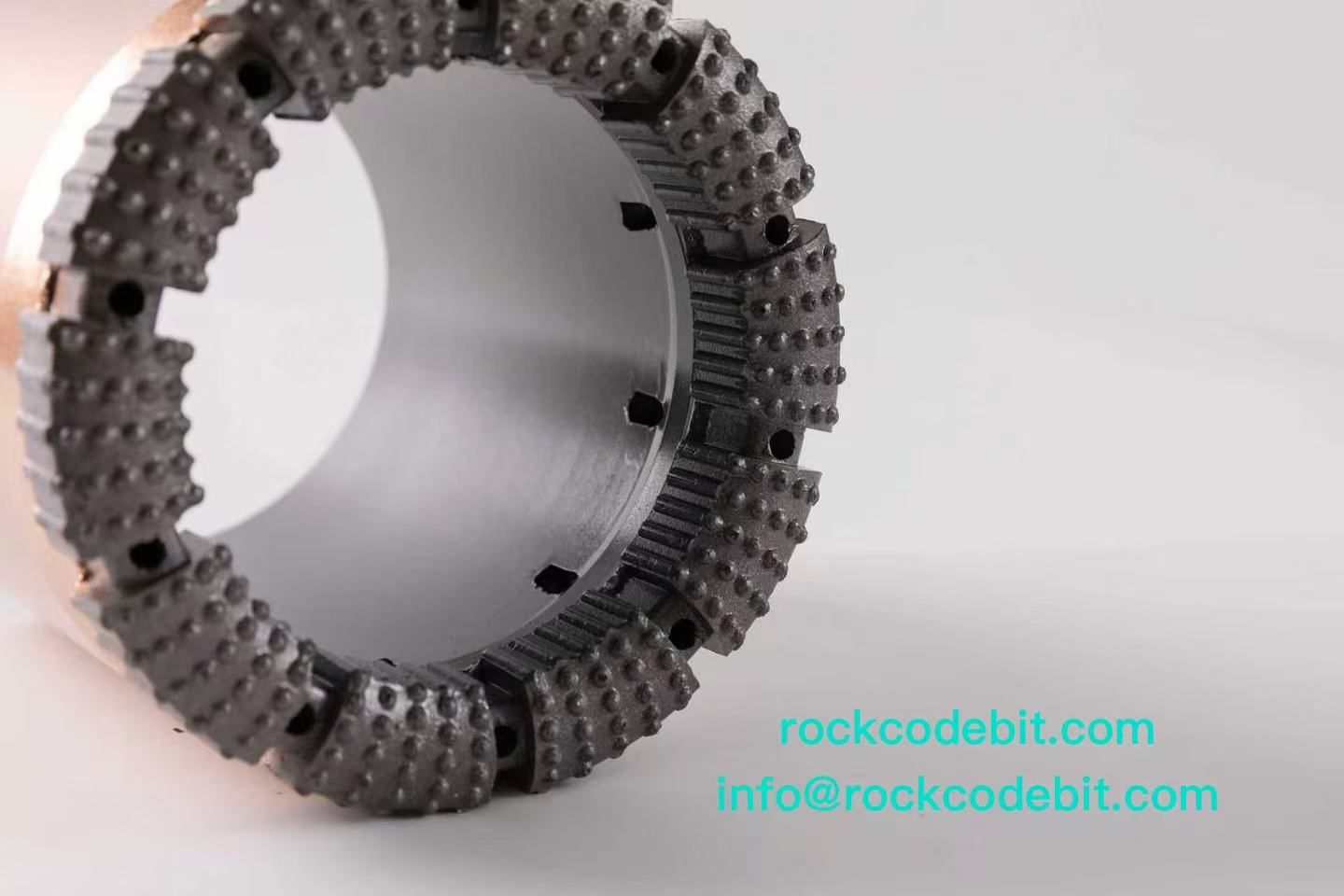
Bit, Core Barrel, and Fluid Circulation
Diamonds are set on the working face of a hollow bit. As the bit advances, an annular kerf is cut, allowing a solid cylindrical core to enter the core barrel. The core is retained by a core lifter or equivalent holding device.
Circulating fluid exits the bit waterways, entrains rock fines, and returns to surface along the annulus between rods and borehole wall. The discharged slurry can be directed to a settling box for inspection or sampling.
Rod strings are periodically withdrawn—commonly every 5 to 10 feet in shallow work, or 20 to 30 feet at depth—to recover core. The recovered core provides a continuous, direct record of the formations penetrated.
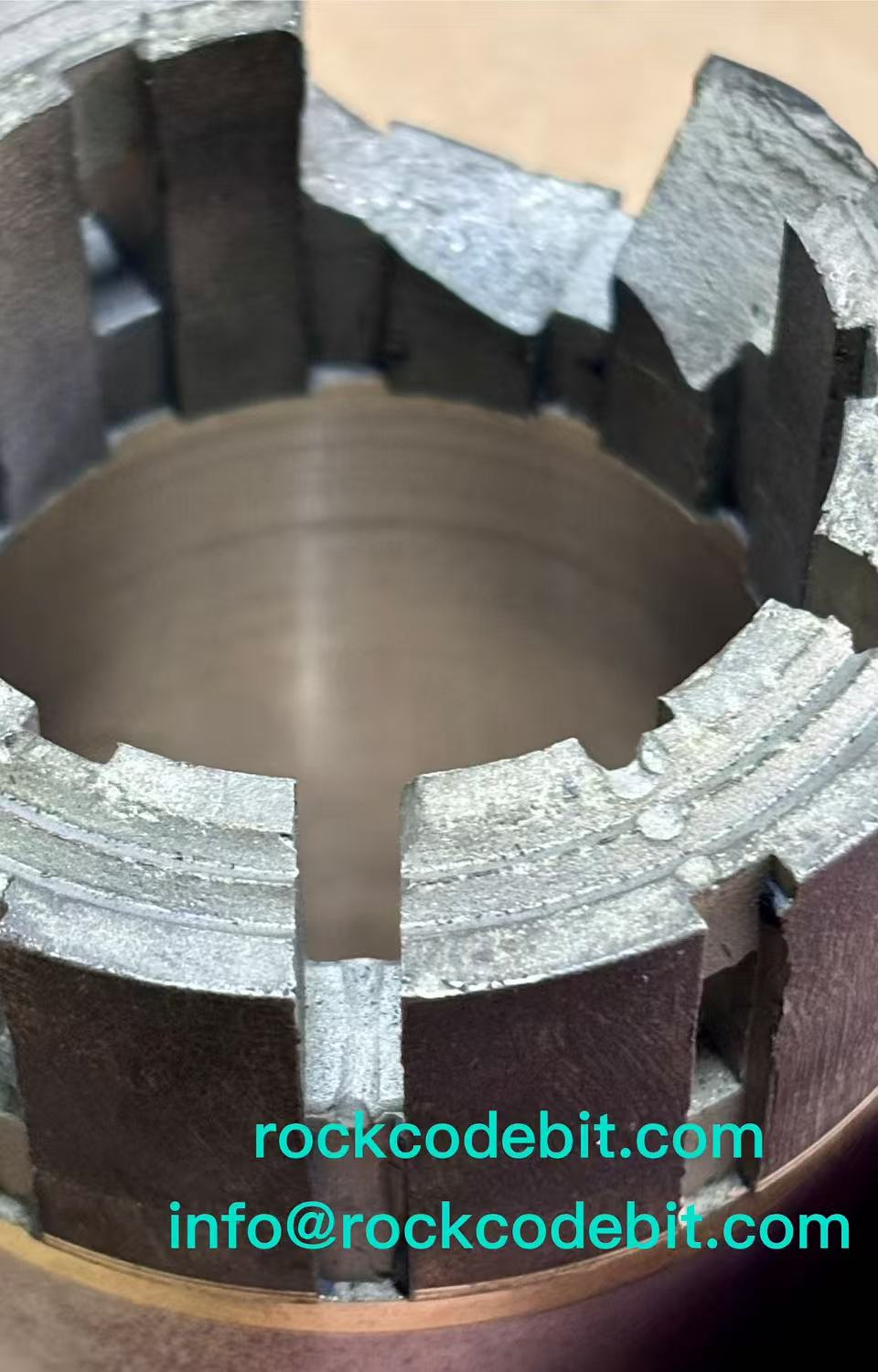
Drill Sizes, Depth Ranges, and Application
Core size and drilling equipment are selected according to depth, logistics, and exploration objective.
• Light and shallow drilling
Small, portable drills may recover cores as small as ¾ inch in diameter, typically to depths of up to ~150 ft. These systems are used for rapid testing, trench sampling, or shallow investigations where speed and mobility are critical.
• Heavy drilling systems
Larger rigs recover cores up to 4 inches in diameter and are capable of exceeding 5,000 ft depth. These rigs are used for deep exploration and, in some cases, underground drilling, although underground work generally favors lighter equipment adapted for drifts and crosscuts.
Drilling costs are typically calculated on a footage basis and vary significantly with:
-
site location and access,
-
overburden conditions,
-
rock structure and competence,
-
water availability,
-
labor, transport, consumables, and diamond usage.
Historical cost figures are useful only as rough references; actual performance and cost are governed by site-specific conditions.
Productivity and Operational Reality
Footage achieved per shift is a critical performance indicator. In shallow drilling, daily advances of 100 ft or more are common under favorable conditions.
As depth increases, penetration rates decline. This is not due solely to slower cutting, but primarily to time lost in rod handling. Core recovery requires uncoupling, stacking, and withdrawing the entire rod string, after which rods must be re-run to bottom. Consequently, only part of an operating shift is spent cutting rock; the remainder is consumed by handling and adjustment tasks.
Drilling Equipment and Feed Systems
A conventional surface drilling outfit includes:
-
the drill unit,
-
power source (historically gasoline engines; modern equivalents may vary),
-
water pumps,
-
drill rods, core barrels, casing, and tools.
Power is transmitted through a clutch and gearbox to both the rotary head and hoisting system.
Two feed mechanisms are commonly used:
-
Screw feed — traditionally common in Canada
-
Hydraulic feed — more prevalent in many other regions
In screw feed systems, rotation is transferred through bevel gears to a quill attached to the feed screw. Spur gear arrangements control feed rate, typically offering multiple gear sets with advances ranging from coarse to very fine (historically on the order of hundreds of screw revolutions per inch of advance). Swivel heads generally allow full 360° rotation for alignment.
Drill rods pass through a two- or three-jaw chuck at the base of the feed mechanism. As the chuck rotates and grips the rods, axial thrust is applied, advancing the bit.
Site Setup and Support Systems
A typical surface setup involves:
-
leveling sill timbers over the collar,
-
bolting the drill to the sills,
-
erecting a lightweight drill shelter,
-
installing a tripod or mast (often ~30 ft high) for rod handling.
Water supply is frequently remote from the drill site. Water may be pumped to a holding tank at the rig using small auxiliary pumps and transported over long distances through hose or pipe, depending on terrain.
Overburden and Casing Practice
Driving casing through overburden remains one of the most challenging aspects of diamond drilling.
Common practices include:
-
mechanically driving standpipe,
-
controlled blasting when boulders are encountered,
-
pre-drilling through large obstructions with a diamond bit before blasting.
To protect casing during blasting, the pipe is typically withdrawn slightly before detonation.
When standpipe reaches bedrock, it is cut off at floor level. Because this alone does not prevent sand or gravel ingress, a flush-joint casing is often run inside the larger pipe. A diamond-set casing bit drills a short distance into competent rock, allowing the casing to be seated and sealing off unconsolidated material.
Alternative methods—such as expansion reamers or heavy mud systems—exist but are generally more expensive and used only when conventional driving reaches its economic or technical limit.
→ For more information about ROCKCODE’s Products, please visit: https://www.rockcodebit.com/drill-bits-products
→ Email us at: info@rockcodebit.com
→ Information in this article is for general reference only. For specific drilling projects and drilling bits, please consult qualified professionals. Thank you.
Source
【1】Cumming, J. D. (1956). Diamond drill handbook. (2nd ed.). Smit.
https://www.rockcodebit.com/diamond-drilling-technical-overview-for-practitioners.html

 English
 Arabic
 French
 Spanish
 Portuguese
 Turkish
 Dutch
Dutch
 Italiano
 Russian
 Romaian
 Portuguese (Brazil)
 Greek
Greek
Warning: Undefined array key "_is_photo" in /home/senmarri/public_html/friend24.in/content/themes/default/templates_compiled/9ea4999d05077b6b690d81624544cd64a51b1299_0.file.__feeds_post.comments.tpl.php on line 27
Warning: Attempt to read property "value" on null in /home/senmarri/public_html/friend24.in/content/themes/default/templates_compiled/9ea4999d05077b6b690d81624544cd64a51b1299_0.file.__feeds_post.comments.tpl.php on line 27
" style="background-image:url(
Warning: Undefined array key "user_picture" in /home/senmarri/public_html/friend24.in/content/themes/default/templates_compiled/19bd7b5d2fc32801d9316dbc2d8c5b25c99e72c3_0.file.__feeds_comment.form.tpl.php on line 31
);">
/home/senmarri/public_html/friend24.in/content/themes/default/templates_compiled/9ea4999d05077b6b690d81624544cd64a51b1299_0.file.__feeds_post.comments.tpl.php on line 128
Warning: Attempt to read property "value" on null in /home/senmarri/public_html/friend24.in/content/themes/default/templates_compiled/9ea4999d05077b6b690d81624544cd64a51b1299_0.file.__feeds_post.comments.tpl.php on line 128
">