
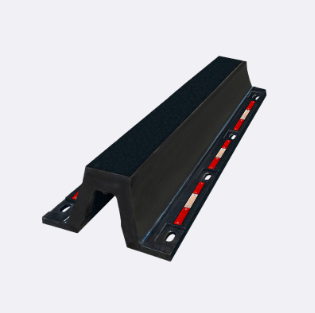
A V Type Rubber Fender is a widely used protective component in marine and port environments, designed to absorb berthing energy and reduce impact forces between vessels and dock structures. Installed along quay walls, jetties, and dolphins, this fender type supports safe docking operations by managing contact loads during approach and mooring. Its shape and material properties make it suitable for a variety of vessel sizes and operating conditions.
The design concept behind a V Type Rubber Fender focuses on controlled deformation. The V-shaped profile allows the rubber body to compress progressively when a vessel makes contact, distributing reaction forces more evenly along the mounting surface. This behavior helps reduce localized stress on both the vessel hull and the supporting structure. Engineers select dimensions and angles based on berthing energy calculations and space constraints at the installation site.
Material selection is a key factor in performance. A V Type Rubber Fender is typically manufactured from durable rubber compounds formulated to withstand repeated compression, seawater exposure, and environmental aging. These compounds are processed to achieve a balance between elasticity and structural stability. Reinforcement elements, such as internal fabric layers or mounting plates, may be incorporated to support load transfer and secure installation.
Manufacturing processes emphasize consistency and durability. During production, rubber is mixed, molded, and vulcanized under controlled conditions to ensure uniform physical properties. Each V Type Rubber Fender is produced according to defined tolerances so that its energy absorption and reaction force characteristics align with design expectations. Controlled curing processes support long-term performance under cyclic loading.
Installation practices also influence overall effectiveness. A V Type Rubber Fender is usually mounted to concrete or steel structures using anchor bolts and backing plates. Proper alignment and spacing are important to ensure that the fender engages evenly during vessel contact. Installation teams follow engineering drawings and torque specifications to secure the fender while allowing it to deform as intended during operation.
Quality inspection is integrated throughout production and delivery. Manufacturers often test a V Type Rubber Fender for compression behavior, dimensional accuracy, and surface integrity. Visual checks help identify defects such as cracks or voids, while sample testing verifies mechanical properties. These inspections support reliable performance once the fender is placed into service at a port or terminal.
Maintenance requirements are relatively straightforward but still important. A V Type Rubber Fender benefits from periodic visual inspection to check for excessive wear, damage from vessel contact, or corrosion of mounting hardware. Cleaning marine growth and debris from the surface helps maintain consistent contact behavior. With routine checks, the fender can remain functional over extended service periods.
As port infrastructure continues to develop, the application of the V Type Rubber Fender remains relevant across both new construction and retrofit projects. While core design principles stay consistent, gradual refinements in rubber formulation and manufacturing control continue to support changing operational demands. Through careful design, controlled production, and proper installation, this fender type continues to provide practical impact protection for marine facilities in diverse operating environments.
https://www.zhhatrte.com/product/rubber-fender/v-type-rubber-fender/

 English
 Arabic
 French
 Spanish
 Portuguese
 Deutsch
 Turkish
 Dutch
Dutch
 Italiano
 Russian
 Portuguese (Brazil)
 Greek
Greek
Warning: Undefined array key "_is_photo" in /home/senmarri/public_html/friend24.in/content/themes/default/templates_compiled/9ea4999d05077b6b690d81624544cd64a51b1299_0.file.__feeds_post.comments.tpl.php on line 27
Warning: Attempt to read property "value" on null in /home/senmarri/public_html/friend24.in/content/themes/default/templates_compiled/9ea4999d05077b6b690d81624544cd64a51b1299_0.file.__feeds_post.comments.tpl.php on line 27
" style="background-image:url(
Warning: Undefined array key "user_picture" in /home/senmarri/public_html/friend24.in/content/themes/default/templates_compiled/19bd7b5d2fc32801d9316dbc2d8c5b25c99e72c3_0.file.__feeds_comment.form.tpl.php on line 31
);">
/home/senmarri/public_html/friend24.in/content/themes/default/templates_compiled/9ea4999d05077b6b690d81624544cd64a51b1299_0.file.__feeds_post.comments.tpl.php on line 128
Warning: Attempt to read property "value" on null in /home/senmarri/public_html/friend24.in/content/themes/default/templates_compiled/9ea4999d05077b6b690d81624544cd64a51b1299_0.file.__feeds_post.comments.tpl.php on line 128
">