
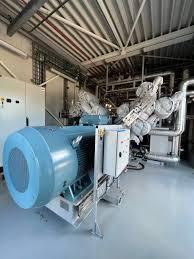
The industrial heat pump market is evolving as performance improvements enable reliable operation across both low and high temperature ranges. Historically associated with low-temperature applications, industrial heat pumps are now capable of meeting a broader spectrum of industrial heating and cooling needs. This expanded performance envelope is strengthening their role in industrial energy efficiency initiatives and decarbonization strategies, making them increasingly relevant across diverse sectors.
Performance characteristics in low-temperature applications
Low-temperature industrial heat pump applications typically include space heating, hot water generation, and process heating at modest temperature levels. In these applications, heat pumps demonstrate exceptionally high efficiency, delivering significant thermal output with minimal energy input. Their ability to utilize ambient heat, ground sources, or waste heat streams further enhances performance.
In industrial settings, low-temperature heat pumps are widely used for cleaning processes, preheating, and auxiliary heating tasks. Their stable operation and high efficiency make them a preferred solution where consistent and reliable low-temperature heat is required.
Efficiency advantages at lower temperature ranges
At lower temperature ranges, industrial heat pumps achieve optimal coefficients of performance. This translates into reduced energy consumption and lower operating costs compared to conventional heating systems. These efficiency advantages are particularly valuable in industries with continuous low-temperature heating demand.
The strong performance at low temperatures has driven early adoption and remains a foundational strength of industrial heat pump technology. It also provides a baseline for evaluating performance improvements at higher temperature levels.
Expanding performance into mid-temperature ranges
Advancements in system design and component technology have enabled industrial heat pumps to perform effectively in mid-temperature ranges. These applications include process heating for drying, pasteurization, and evaporation, which were previously served primarily by fossil fuel-based systems.
Improved compressors, enhanced refrigerants, and optimized heat exchangers allow heat pumps to deliver higher output temperatures without sacrificing efficiency. This expansion significantly increases the number of industrial processes that can be electrified using heat pump technology.
High-temperature heat pump performance evolution
High-temperature industrial heat pumps represent a key area of innovation within the market. These systems are designed to deliver thermal energy at temperature levels suitable for more demanding industrial processes. While efficiency at high temperatures is naturally lower than at low-temperature operation, modern systems offer competitive performance and reliability.
The ability to operate in high-temperature ranges reduces reliance on combustion-based heating and supports deeper industrial decarbonization. High-temperature heat pumps are increasingly considered for applications such as industrial drying, distillation support, and advanced manufacturing processes.
Trade-offs between efficiency and temperature capability
Performance evaluation across temperature ranges highlights an important trade-off between efficiency and temperature output. As required temperatures increase, energy input rises and overall efficiency declines. However, ongoing technological improvements are narrowing this gap, making high-temperature heat pumps more attractive for industrial use.
Industries evaluate these trade-offs based on process requirements, energy costs, and sustainability goals. In many cases, combining heat pumps with other technologies or using them for specific stages of a process optimizes overall performance.
Reliability and operational stability across ranges
Reliability is a critical factor in evaluating heat pump performance across temperature ranges. Industrial heat pumps are increasingly designed to maintain stable operation under continuous and variable load conditions. Robust system components and advanced control strategies support consistent performance across both low and high temperature applications.
Operational stability enhances confidence among industrial users, particularly in sectors where downtime can have significant economic impact. This reliability supports wider adoption across diverse industrial environments.
Integration with waste heat recovery
Performance across temperature ranges is further enhanced through integration with waste heat recovery systems. By using waste heat as an input source, heat pumps improve efficiency even at higher output temperatures. This integration reduces overall energy demand and strengthens the economic and environmental case for adoption.
Waste heat recovery allows industrial heat pumps to bridge the gap between low-grade heat availability and higher process temperature requirements.
Market implications and adoption trends
The ability of industrial heat pumps to perform across a wide temperature spectrum is reshaping market adoption trends. Industries that once considered heat pumps unsuitable for their thermal needs are now reevaluating their potential. This shift is expanding the addressable market and driving innovation among technology providers.
As performance continues to improve, industrial heat pumps are expected to play a larger role in both low- and high-temperature process applications, supporting broader electrification of industrial heat.
Outlook for temperature-based performance
Looking ahead, ongoing research and development will further enhance performance across temperature ranges. Continued innovation in refrigerants, compressors, and system integration will improve efficiency and reliability at higher temperatures while maintaining strengths at lower ranges.
The industrial heat pump market outlook reflects growing confidence in their ability to deliver versatile and dependable performance. By effectively addressing both low and high temperature requirements, industrial heat pumps are positioned as a key technology in the future of sustainable industrial energy systems.

 Arabic
 French
 Spanish
 Portuguese
 Deutsch
 Turkish
 Dutch
Dutch
 Italiano
 Russian
 Romaian
 Portuguese (Brazil)
 Greek
Greek
Warning: Undefined array key "_is_photo" in /home/senmarri/public_html/friend24.in/content/themes/default/templates_compiled/9ea4999d05077b6b690d81624544cd64a51b1299_0.file.__feeds_post.comments.tpl.php on line 27
Warning: Attempt to read property "value" on null in /home/senmarri/public_html/friend24.in/content/themes/default/templates_compiled/9ea4999d05077b6b690d81624544cd64a51b1299_0.file.__feeds_post.comments.tpl.php on line 27
" style="background-image:url(
Warning: Undefined array key "user_picture" in /home/senmarri/public_html/friend24.in/content/themes/default/templates_compiled/19bd7b5d2fc32801d9316dbc2d8c5b25c99e72c3_0.file.__feeds_comment.form.tpl.php on line 31
);">
/home/senmarri/public_html/friend24.in/content/themes/default/templates_compiled/9ea4999d05077b6b690d81624544cd64a51b1299_0.file.__feeds_post.comments.tpl.php on line 128
Warning: Attempt to read property "value" on null in /home/senmarri/public_html/friend24.in/content/themes/default/templates_compiled/9ea4999d05077b6b690d81624544cd64a51b1299_0.file.__feeds_post.comments.tpl.php on line 128
">