
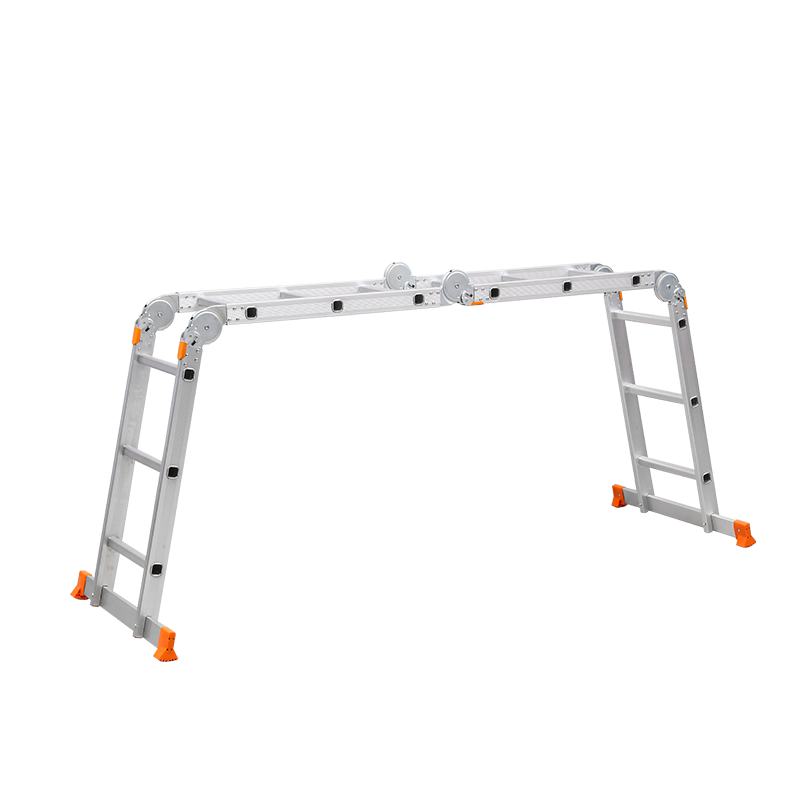
The single ladder represents one of the most fundamental and enduring forms of access equipment, a tool defined by its simplicity and singular purpose. Consisting of a single, rigid section with fixed rungs spanning two side rails, this ladder is designed for straightforward, non-adjustable vertical or slightly inclined ascent. Unlike extension or multi-purpose ladders, a single ladder has no moving parts to adjust or lock; its usability is defined entirely by its fixed length. This inherent simplicity makes the single ladder a common sight in homes, workshops, and job sites for tasks that require reaching a specific, consistent height. Its presence is often taken for granted, yet its correct selection and safe use are foundational to countless maintenance and construction activities. This discussion will outline the basic design principles, appropriate applications, and critical safety considerations for this essential tool, concluding with a reaffirmation of the single ladder's irreplaceable role in providing simple, reliable access.
The construction of a typical single ladder prioritizes strength, stability, and durability. The side rails, the two main longitudinal supports, are traditionally made from wood, aluminum, or fiberglass. Each material offers distinct properties: wood provides a solid, non-conductive feel but requires more maintenance; aluminum is lightweight and resistant to weather but conducts electricity; fiberglass combines strength with electrical non-conductivity, making it suitable for electrical work. The rungs, or steps, are securely attached between the side rails at a uniform spacing that complies with safety standards, providing a consistent climbing experience. The top and bottom of the side rails are often fitted with protective caps or shoes. On a single ladder, these end caps serve to protect the material from splitting (in wood) and to provide a degree of slip resistance when the ladder is placed on a hard surface. The entire design is an exercise in creating a balanced, portable structure that can safely transfer a user's weight.
Determining the correct working height is the primary consideration when using a single ladder. The usable reach of a person on a ladder is not the same as the ladder's length. Safety guidelines dictate that a user should not stand on the top three rungs of a straight single ladder, as this does not provide a secure handhold for balance. Therefore, a single ladder must be long enough so that the task can be accomplished while the climber's feet remain at or below this safe level. For example, to safely reach a gutter at 16 feet high, a longer single ladder is required than the raw height would suggest. This calculation is essential; using an improperly short single ladder encourages dangerous overreaching, while an excessively long one can be unwieldy to transport and position.
Safety in practice depends heavily on proper setup and climbing technique. The single ladder must be placed on a firm, level surface. The angle of inclination is crucial; a general rule is the "four-to-one" ratio: for every four feet of ladder height, the base should be one foot away from the vertical support surface. This angle provides a stable compromise between leaning too steeply (risk of falling backward) and too shallow (risk of the base slipping out). Before climbing, the user should visually inspect the single ladder for any damage, such as cracks, loose rungs, or worn caps. When ascending or descending, the climber should maintain three points of contact (two hands and one foot, or two feet and one hand) and face the ladder at all times, avoiding carrying heavy or bulky items that could upset balance.
The single ladder remains a testament to the effectiveness of straightforward, purpose-built design. It fulfills a clear need—safe, temporary access to elevated points—without unnecessary complexity. Its value lies not in adaptability but in its reliability within its defined parameters. When selected for an appropriate task, inspected carefully, and used according to established safety protocols, a single ladder is a dependable partner for everything from changing a lightbulb to painting a ceiling. As one of the most basic tools for overcoming vertical distance, the single ladder continues to hold an essential place in our toolkit, a simple yet profound mechanism that quite literally supports our efforts to rise to the occasion. Its persistent utility underscores that for many tasks, a dedicated, well-understood tool like the single ladder is often the most effective solution available.

 English
 Arabic
 French
 Portuguese
 Deutsch
 Turkish
 Dutch
Dutch
 Italiano
 Russian
 Romaian
 Portuguese (Brazil)
 Greek
Greek
Warning: Undefined array key "_is_photo" in /home/senmarri/public_html/friend24.in/content/themes/default/templates_compiled/9ea4999d05077b6b690d81624544cd64a51b1299_0.file.__feeds_post.comments.tpl.php on line 27
Warning: Attempt to read property "value" on null in /home/senmarri/public_html/friend24.in/content/themes/default/templates_compiled/9ea4999d05077b6b690d81624544cd64a51b1299_0.file.__feeds_post.comments.tpl.php on line 27
" style="background-image:url(
Warning: Undefined array key "user_picture" in /home/senmarri/public_html/friend24.in/content/themes/default/templates_compiled/19bd7b5d2fc32801d9316dbc2d8c5b25c99e72c3_0.file.__feeds_comment.form.tpl.php on line 31
);">
/home/senmarri/public_html/friend24.in/content/themes/default/templates_compiled/9ea4999d05077b6b690d81624544cd64a51b1299_0.file.__feeds_post.comments.tpl.php on line 128
Warning: Attempt to read property "value" on null in /home/senmarri/public_html/friend24.in/content/themes/default/templates_compiled/9ea4999d05077b6b690d81624544cd64a51b1299_0.file.__feeds_post.comments.tpl.php on line 128
">